Heilimä Challenges Industry Professionals to Attend the Tekijäpäivät Event
Technology and skill requirements in the automotive aftermarket are evolving rapidly. Harri Heilimä, chairman of the board of the Association of Automotive Service Providers, challenges industry professionals to take a break from their busy daily routines and attend the Tekijäpäivät event in Vantaa on October 2–3 October.
“Change in the auto repair industry is happening so fast right now that no one can claim to already know everything they need to know.” Tekijäpäivät offers a great opportunity to get a comprehensive overview of the latest developments in the industry and the direction in which the field is heading, all in one place,” Heilimä encourages.
Organized by the Association of Automotive Service Providers, Tekijäpäivät brings together professionals, companies, and students at the country’s newest vocational school in the field— the Vehkala campus of Vantaa Vocational College Varia, bringing together automotive repair professionals, companies, students, and the latest products, tools, and services. The event stands out from typical trade shows particularly because of its setting: new products are showcased in an authentic, modern auto repair and educational setting where visitors can actually do everything that’s typically done in a workshop.
The program includes live demonstrations, expert presentations, and hands-on demonstrations. A wide range of topics will be covered, including repair technology, replacement parts, body repair and painting, tire technology, battery and electric vehicle technology, information systems, and training. The program also includes demonstrations on electric vehicle battery safety and a panel discussion on the implementation of battery regulations in Finland.
According to Heilimä, the event is also worth attending to meet colleagues and exchange ideas about what’s currently happening at workshops.
– The whole point of Tekijäpäivät is hands-on engagement. Come see, try things out, ask questions, and join the conversation. I challenge every professional in the field to use this day to develop their own expertise and their business.
The “Tekijäpäivät” event will be held in Vantaa on October 2–3, 2026. The event is open to professionals on Friday from 1:00 p.m. to 6:00 p.m. and on Saturday from 9:00 a.m. to 4:00 p.m. Admission is free but requires advance registration. On Saturday evening, the festivities continue at a hotel in Vantaa with an Oktoberfest celebration organized by automotive professionals.
More information about the events and ticket reservations
Finland’s EV fleet growth falls short of expectations
Finland’s EV fleet growth remains slower than expected, while the country’s ageing vehicle fleet continues to sustain demand for conventional maintenance and repair services. According to Harri Heilimä, chairman of the Finnish Association of Automotive Service Providers (AAPT), electrification has so far had only a limited impact on the association’s member companies. Nevertheless, battery faults and repairs are expected to create new business opportunities for independent workshops.
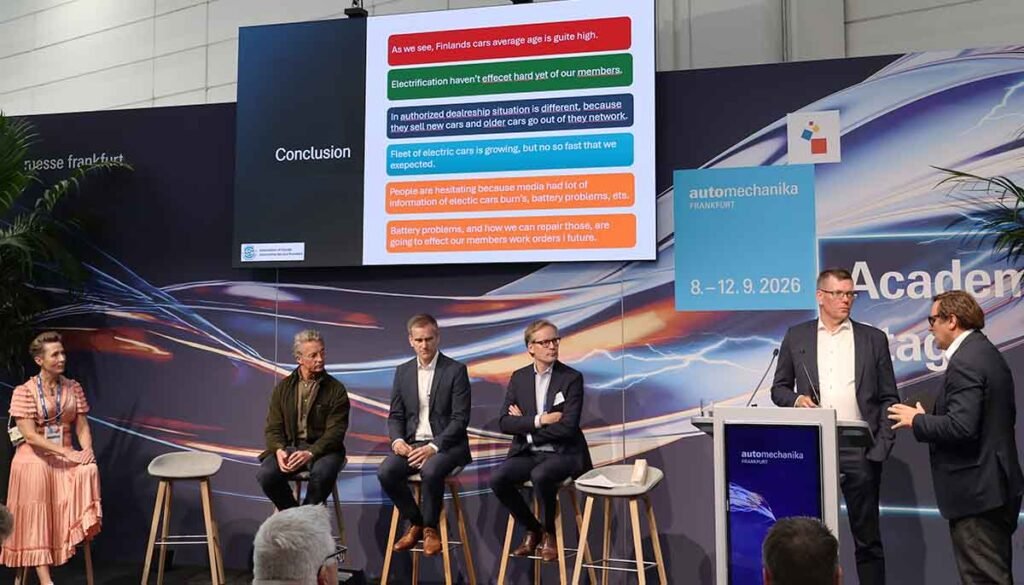
Chairman Harri Heilimä, The Association of Automotive Service Providers examined the electrification of Finland’s aftermarket at The Focus on Nordic IAM event organized by Automediat.com at Automechanika Frankfurt on September 9, 2026. His presentation described this shift from the perspective of repair shops’ current customer base and the slowly renewing vehicle fleet.
The influence of the Association of Automotive Service Providers is growing
The Association of Automotive Service Providers (AAPT), which Heilimä represents, comprises independent companies in the maintenance, collision repair, painting, and spare parts sectors. According to the presentation, the association has 250 members and 450 locations throughout Finland. Member companies employ approximately 4,500 people.
The high average age of Finland’s passenger car fleet was a key point in Heilimä’s presentation. A graph based on data from Statistics Finland showed that the vehicle fleet has aged over the long term. Gasoline and diesel cars continued to make up the vast majority of the passenger car fleet described in the presentation.
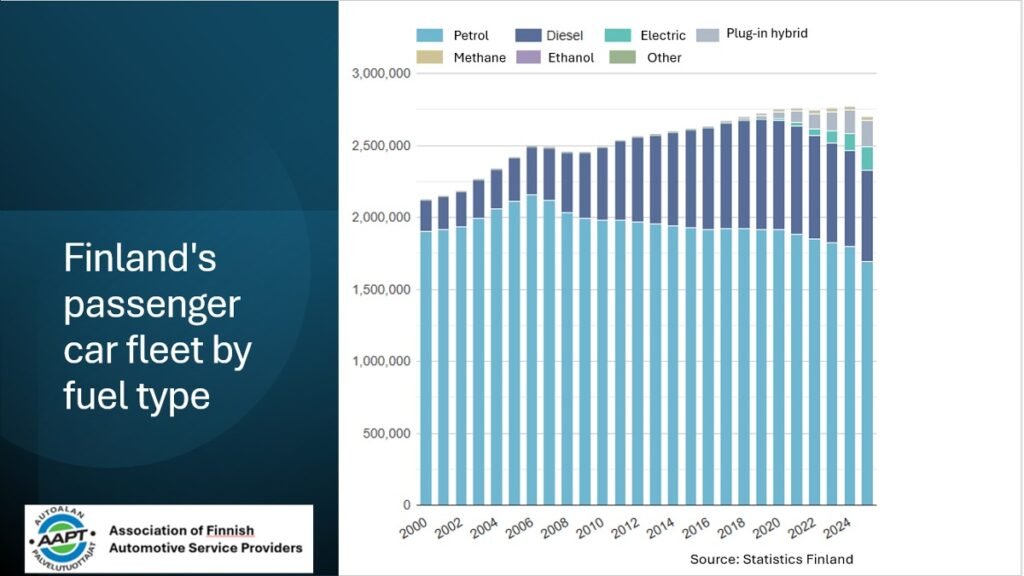
The renewal of Finland’s automotive sector will take time
At the same time, new car registrations have declined significantly from the levels seen in the late 2010s. The share of fully electric cars and plug-in hybrids among new cars has grown, but the renewal of the entire vehicle fleet will take time. From the perspective of repair shops’ workload and service needs, the types of cars their customers drive are crucial.
Heilimä highlighted the difference between independent repair shops and brand-authorized dealerships. Brand-authorized dealerships sell new cars and are thus facing the effects of electrification earlier. As cars age, they are transferred to service providers outside the brand network. This helps explain why electrification has had only a limited impact on AAPT member companies so far.
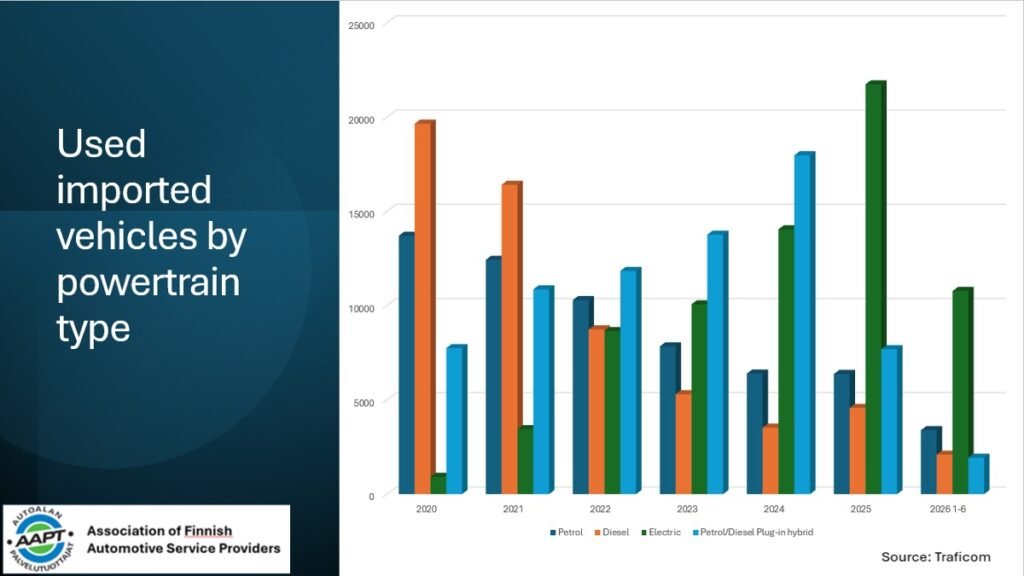
The need for repairs on used all-electric vehicles is growing
However, the import of used cars is also changing the future customer base of independent repair shops. According to Traficom data presented by Heilimä, fully electric vehicles accounted for the largest powertrain category in used car imports for both 2025 and the first half of 2026. Electric vehicles are thus also entering Finland’s vehicle fleet as used cars.
According to Heilimä, the electric vehicle fleet is growing, but more slowly than expected. He believes that news reports about battery problems and electric vehicle fires are increasing consumer hesitation.
Heilimä highlighted battery faults and repairs as a future area of focus for independent repair shops. He believes that both battery problems and the ability to repair them will continue to influence the work orders received by AAPT member companies. This will bring a new type of repair work alongside the maintenance needs of the current vehicle fleet.
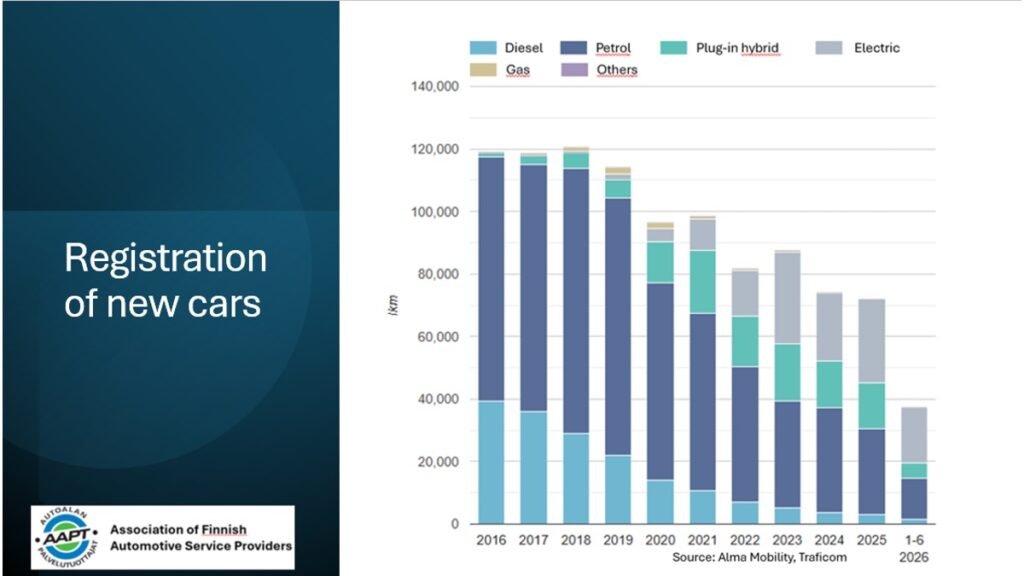
Source: Harri Heilimä, “How Has Electrification Affected Finland’s Automotive Aftermarket?”, updated presentation materials for the Automechanika Frankfurt 2026 event. Membership figures: slide 1. Registrations, vehicle fleet, and used car imports: slides 3, 5–6, and 8. Conclusions: slide 9.
Reporter: Valentina Ahlavuo, Automediat.com
Focusing on the Nordic aftermarket
Four markets bring the EV service transition into focus at Automechanika Frankfurt 2026
Nordic workshops and suppliers are preparing for electric vehicles at markedly different speeds. At Automechanika Frankfurt 2026, AUTOMEDIAT’s second Nordic independent aftermarket (IAM) panel examined how the region can develop EV repair capacity while sustaining the conventional business that still supports much of the sector. [1, 4–7]
Organised by Finnish aftermarket media company Automediat.com in cooperation with Messe Frankfurt, The Focus on Scandinavian Aftermarket took place on 9 September at the Academy Stage in Hall 8.0. The session was led by publisher and editor-in-chief Valentina Ahlavuo and moderated by Italian automotive journalist Tommaso Caravani. Messe Frankfurt’s Gateway to Automotive selected the session as one of its ten programme highlights. [1]
Antti Wolk of Wolk & Nikolic After Sales Intelligence
The differences were clear in the market data presented by Antti Wolk of Wolk & Nikolic After Sales Intelligence. His 2025 benchmarks put the battery-electric vehicle (BEV) share of the fleet at 36.5% in Norway, 17.5% in Denmark, 8.8% in Sweden and 4.8% in Finland. Based on census data and forecasts, these figures describe fleet composition, which, alongside vehicle age, helps determine demand for EV servicing and repairs. [4]
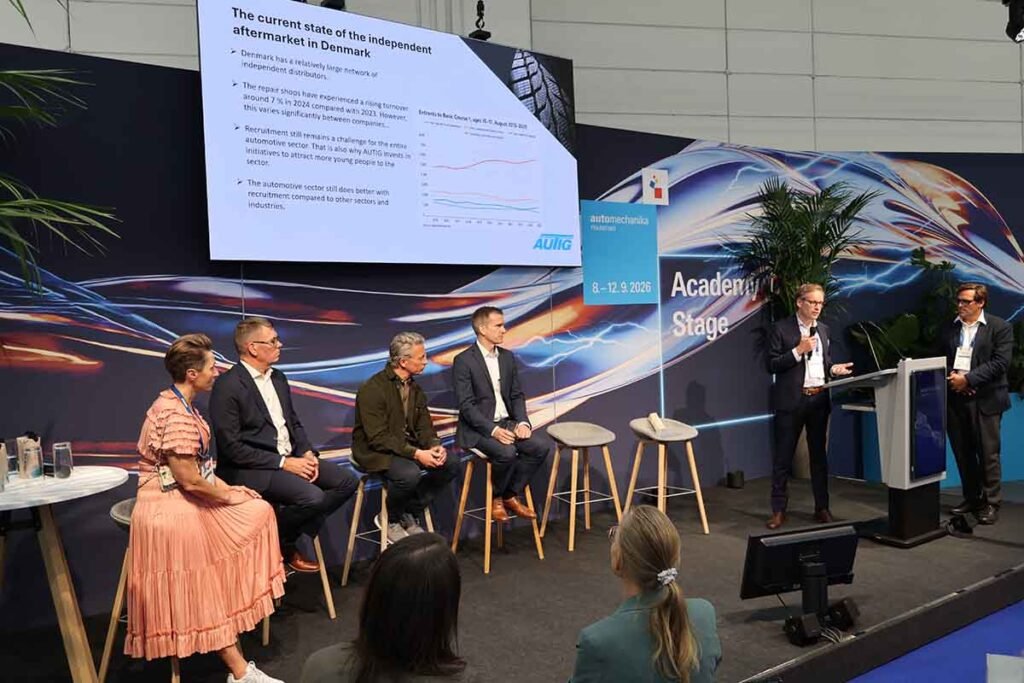
Mads Engberg, director of AUTIG and president of FIGIEFA
Denmark illustrates the gap between new car registrations and the composition of the overall fleet. Mads Engberg, director of AUTIG and president of FIGIEFA, reported that electric vehicles accounted for 79.9% of new passenger car registrations in the first half of 2026 and 22.9% of the passenger car fleet in July. He identified conventional combustion-engine vehicles as the main drivers of independent aftermarket growth. [7]
Harri Heilimä, chair of the Finnish Association of Automotive Service Providers, AAPT
Finland faces a different timetable. Harri Heilimä, chair of the Finnish Association of Automotive Service Providers, AAPT, described a market shaped by an ageing fleet. Electrification had so far had a limited impact on the association’s members, although battery faults and repairs were identified as a future source of work. Finnish independents therefore need to develop new capabilities alongside the services required by their existing customers. [5]
The commercial structure of the Nordic aftermarket also affects how businesses prepare. Wolk’s 2025 benchmark put independent aftermarket distribution and retail company revenue in the region at €8.98 billion. The five largest companies accounted for 43.2% of that revenue, compared with a 16.4% share for the five largest companies in the wider European comparison. [4]
Workshop networks also play a substantial role. In Wolk’s 2024 passenger car workshop dataset, 55.6% of Nordic independent workshops belonged to a chain, franchise or other organised system, compared with 28.4% elsewhere in the European comparison. For suppliers, this points to the importance of relationships with established distribution groups and workshop networks. [4]
Lars Bergmark, head of Svenska Fordonsbranschen
Lars Bergmark, head of Svenska Fordonsbranschen, estimated Sweden’s annual independent aftermarket turnover at approximately SEK 30 billion, excluding labour, with around 25,000 people employed in the sector. He highlighted access to vehicle data and digital service records as practical competition issues, alongside training and keeping technical knowledge current. [6]
Engberg connected these concerns to the European regulatory agenda, calling for modernised rules, effective enforcement, recruitment and training. For independent repairers, the transition depends on access to the information and systems needed to carry out the work, as well as investment in equipment and skills. [7]
On the exhibition floor, Denmark’s BORG Automotive provided a concrete example of the emerging EV repair business. It won the Sustainable Drive Solutions category of the Automechanika Innovation Awards for its remanufactured eDrive motor. According to Messe Frankfurt, the company had developed a remanufacturing process and produced samples for vehicles from two carmakers. [8]
The panel and award formed part of a wider Nordic presence at the fair. Held from 8 to 12 September, Automechanika Frankfurt attracted 4,400 exhibitors from 80 countries and more than 112,000 trade visitors from 173 countries, according to Messe Frankfurt. The official directory listed 52 exhibitor entries across Sweden, Denmark, Finland and Norway. Combined visitor attendance from those markets rose 8.4% to 3,613 compared with 2024, with Norway recording the largest increase. [2, 3, 9]
Nordic Participation in Automechanika Frankfurt 2026
| Country | Exhibitors entries 2026 | Visitors 2026 | Visitors 2024 | Visitors change-% |
|---|---|---|---|---|
| Sweden | 22 | 1,146 | 1,096 | +4.6% |
| Finland | 5 | 974 | 875 | +11.3% |
| Denmark | 21 | 850 | 837 | +1.6% |
| Norway | 4 | 643 | 526 | +22.2% |
| Total | 52 | 3,613 | 3,334 | +8.4% |
Exhibitor entries follow the country classification in the official directory, checked on 17 September 2026. Visitor figures supplied by AUTOMEDIAT; percentage changes calculated against 2024. [3, 9]
Swedish exhibitors included Autocom, Car-O-Liner and CTEK, while Denmark’s included Nissens, BORG Automotive and Triscan. Finland was represented by FennoSteel, Maston, RVS Technology, Sinituote and Vepro. Norway’s entries were AutoSock, Brodreskift Tech, DEFA and Lumen Systems. [3]
For independent businesses, the Nordic experience points to a practical approach: match EV investment to the local vehicle fleet, secure the skills and data access needed for new repairs, and retain the capacity to serve existing customers throughout the transition.
Sources and Editorial Notes
[1] Automediat.com, The Focus on Scandinavian Aftermarket programme, 9 September 2026. Second edition confirmed in the author’s supplied text. Panel programme. Messe Frankfurt, Gateway to Automotive, 7 September 2026. Ten programme highlights. The exact total of 616 events in the supplied revision could not be confirmed in the linked public sources and has been omitted.
[2] Messe Frankfurt, final report for the trade press, 14 September 2026. Final report
[3] Messe Frankfurt, Exhibitors and Products 2026. Country-filter results checked on 17 September 2026. Counts use exhibitor location; they do not consolidate all Nordic-owned groups or their foreign subsidiaries. Norway | Finland | Sweden | Denmark
[4] Antti Wolk, Nordic-Automotive-Aftermarket-2026-Wolk_update(1).pdf, August 2026. Slides 4–5: 2025 distribution and retail company revenue and concentration. Slide 8: 2025 BEV fleet benchmarks, sourced to census data and forecasts. Slide 10: 2024 passenger car workshop affiliation.
[5] Harri Heilimä, How Has Electrification Affected Finland’s Automotive Aftermarket_v2(1).pptx. Slide 9: ageing fleet, limited impact of electrification on AAPT members so far, and future battery repair work.
[6] Lars Bergmark, Svenska Fordonsbranschen-Automechanika 2026 v2(1).pptx. Swedish turnover excludes labour. Priorities include vehicle data, digital service records and technical competence.
[7] Mads Engberg, Præsentationen ved Automechanika Frankfurt.pptx. Registration figures cover January–June 2026; fleet share refers to July 2026. The presentation describes these vehicles as electric vehicles. Regulatory reform, enforcement, recruitment and training are among its priorities.
[8] Messe Frankfurt, Innovation Award winners 2026, Sustainable Drive Solutions category. BORG Automotive remanufactured eDrive motor
[9] National visitor counts for 2026 and 2024 supplied by AUTOMEDIAT for this feature. The underlying attendance report was not supplied. Totals and percentage changes are calculated from the provided figures and rounded to one decimal place.