Finland’s EV fleet growth falls short of expectations
Finland’s EV fleet growth remains slower than expected, while the country’s ageing vehicle fleet continues to sustain demand for conventional maintenance and repair services. According to Harri Heilimä, chairman of the Finnish Association of Automotive Service Providers (AAPT), electrification has so far had only a limited impact on the association’s member companies. Nevertheless, battery faults and repairs are expected to create new business opportunities for independent workshops.
Chairman Harri Heilimä, The Association of Automotive Service Providers examined the electrification of Finland’s aftermarket at The Focus on Nordic IAM event organized by Automediat.com at Automechanika Frankfurt on September 9, 2026. His presentation described this shift from the perspective of repair shops’ current customer base and the slowly renewing vehicle fleet.
The influence of the Association of Automotive Service Providers is growing
The Association of Automotive Service Providers (AAPT), which Heilimä represents, comprises independent companies in the maintenance, collision repair, painting, and spare parts sectors. According to the presentation, the association has 250 members and 450 locations throughout Finland. Member companies employ approximately 4,500 people.
The high average age of Finland’s passenger car fleet was a key point in Heilimä’s presentation. A graph based on data from Statistics Finland showed that the vehicle fleet has aged over the long term. Gasoline and diesel cars continued to make up the vast majority of the passenger car fleet described in the presentation.
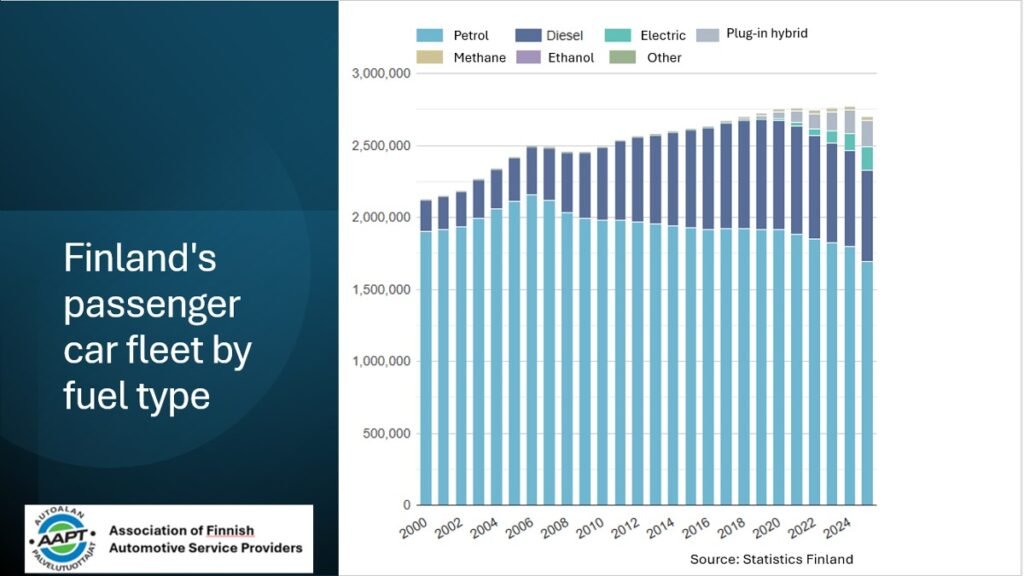
The renewal of Finland’s automotive sector will take time
At the same time, new car registrations have declined significantly from the levels seen in the late 2010s. The share of fully electric cars and plug-in hybrids among new cars has grown, but the renewal of the entire vehicle fleet will take time. From the perspective of repair shops’ workload and service needs, the types of cars their customers drive are crucial.
Heilimä highlighted the difference between independent repair shops and brand-authorized dealerships. Brand-authorized dealerships sell new cars and are thus facing the effects of electrification earlier. As cars age, they are transferred to service providers outside the brand network. This helps explain why electrification has had only a limited impact on AAPT member companies so far.
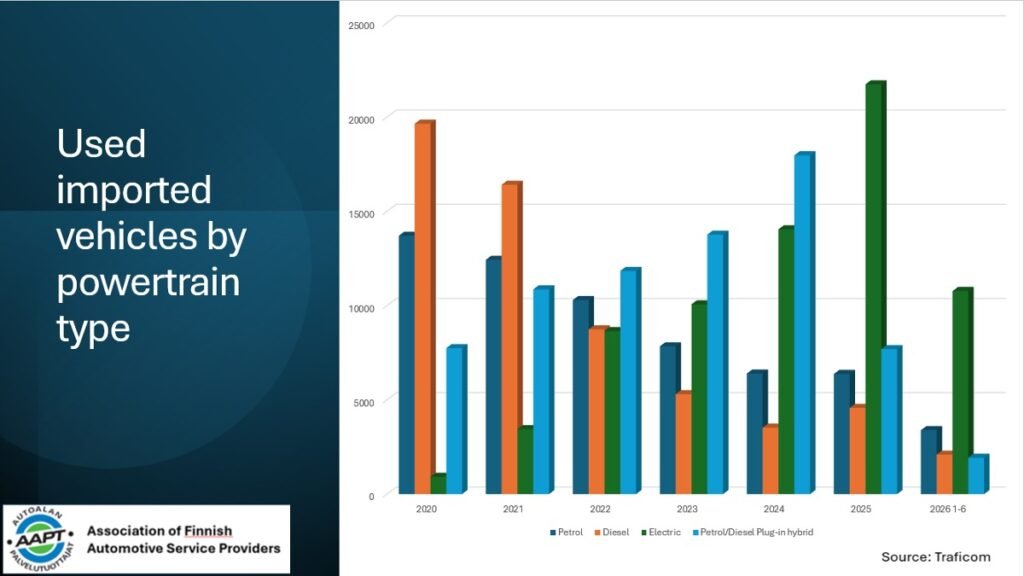
The need for repairs on used all-electric vehicles is growing
However, the import of used cars is also changing the future customer base of independent repair shops. According to Traficom data presented by Heilimä, fully electric vehicles accounted for the largest powertrain category in used car imports for both 2025 and the first half of 2026. Electric vehicles are thus also entering Finland’s vehicle fleet as used cars.
According to Heilimä, the electric vehicle fleet is growing, but more slowly than expected. He believes that news reports about battery problems and electric vehicle fires are increasing consumer hesitation.
Heilimä highlighted battery faults and repairs as a future area of focus for independent repair shops. He believes that both battery problems and the ability to repair them will continue to influence the work orders received by AAPT member companies. This will bring a new type of repair work alongside the maintenance needs of the current vehicle fleet.
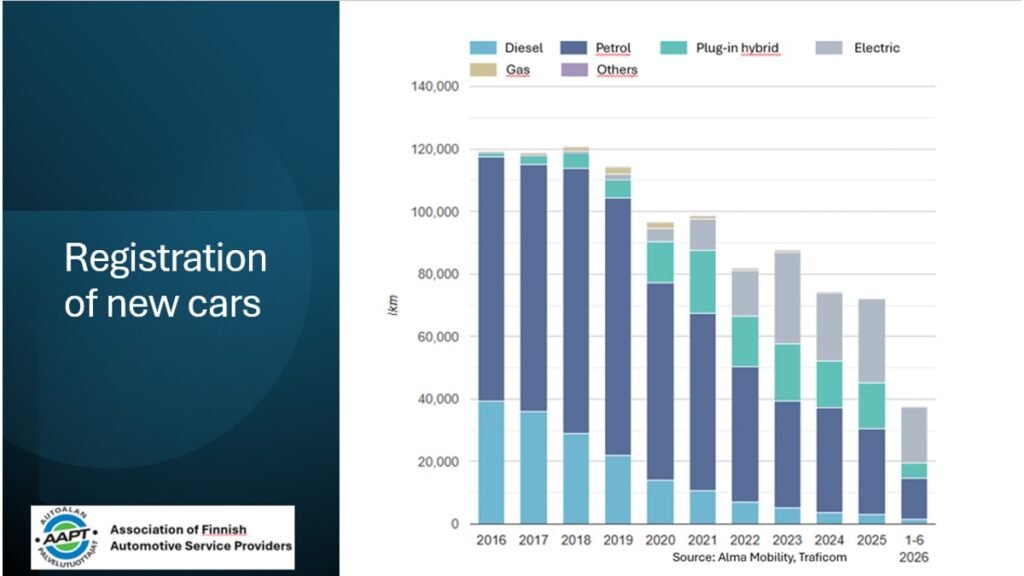
Source: Harri Heilimä, “How Has Electrification Affected Finland’s Automotive Aftermarket?”, updated presentation materials for the Automechanika Frankfurt 2026 event. Membership figures: slide 1. Registrations, vehicle fleet, and used car imports: slides 3, 5–6, and 8. Conclusions: slide 9.
Reporter: Valentina Ahlavuo, Automediat.com
Henri Haapamäki encourages people to attend The Factor Days:
“A modern repair shop isn’t just an old grease pit”
Henri Haapamäki, a motorsports jack-of-all-trades known for his career in auto racing, YLE’s rally broadcasts, and social media, keeps a close eye on trends across the automotive industry and holds repair shop and tire industry experts in high regard. He takes a very practical approach to his own car.
A car is a tool, not a status symbol
Although Haapamäki has gotten to know all kinds of cars during his career—and, for example, test-drives and showcases new cars in social media videos—in his own driveway sits a Ford Mondeo with over 350,000 kilometers on the odometer. People have often questioned his choice of car, especially at more upscale automotive events.
For many people today, a car is a status symbol, but Haapamäki sees things differently. “It’s not my style to buy a new car on credit and trade it in every two years. I buy a car, drive it until it’s done, and repair and maintain it for as long as it makes sense and is necessary,” he explains.
Thus, Haapamäki acquired his current Mondeo after careful consideration. “I work closely with a large car dealership, and I asked them directly what the latest Ford model was that didn’t yet have an AdBlue system or an EcoBoost engine. I wanted a car with a traditional, so-called ‘old-school’ diesel engine and not too many bells and whistles.”
As a buyer of a new car, you have to be prepared to pay not only for the price of the car but also for maintenance, service, and depreciation, Haapamäki points out.
Chinese competition is disrupting pricing models
Some car brands hold their value better than others—for example, traditional Porsches and Mercedes-Benzes have a relatively stable resale value. However, Chinese car brands are currently shaking things up as they are being aggressively pushed into the European car market.
Although Haapamäki does not believe we’ll see direct import restrictions at Europe’s borders, he is nevertheless convinced that Chinese cars will disrupt the traditional car trade and its profit margins. Chinese technology and the pace of its development should be taken seriously, Haapamäki says.
“I work a lot with robotic lawn mowers, and they’re experiencing a phenomenon similar to what’s happening in the auto industry. A mower from a traditional manufacturer might cost, say, 4,000 euros. Now the first Chinese alternatives are entering the market, priced at around 1,500 euros,” he explains.
Haapamäki has noticed that even first-generation Chinese products can feature highly advanced electronics. In addition, Chinese manufacturers respond quickly to feedback and continue to improve their products. The product quickly becomes high-quality, while the price remains at a completely different level. The same could happen with cars.
“We tend to assume that a Chinese product is automatically bad. However, this isn’t always the case. From China, you get the quality you order—and are willing to pay for.”
Valuing Expertise in the Automotive Industry
Haapamäki values the expertise of professionals in the repair and tire industries. He is skeptical of the trend where repair shops are adding tire services to their offerings and tire shops, in turn, are starting repair operations.
“I’m used to a model where one company focuses on one thing. I don’t think it’s ideal for, say, a summer worker or a mechanic who’s just started on the job to change a car’s oil and, at the same time, be tasked with choosing new tires for it. There’s a risk that the tires will be chosen completely wrong—for example, by using ChatGPT,” Haapamäki says.
“If another professional has been working with tires for 40 years and has continuously kept up with developments in the market, tire technology, and regulations, I trust their expertise more. I believe every field should have its own expert who truly masters that specific work.”
Insights from The Factor Days for Everyone Interested in the Automotive Industry
Haapamäki has extensive experience collaborating with various automotive industry experts. This is also evident in his work at The Factor Days, where Haapamäki has served as a host for several years. This year, he’s producing videos for the The Factor Days event, which will be published on AAPT’s channels and shared on Haapamäki’s own social media channels.
“I’ll be interviewing five participants at Creators’ Days. I’ll ask the companies what they do and what they’re bringing to The Factor Days,” Haapamäki explains. “The goal is to get repair shop professionals out and about and show how much effort has gone into the event’s content.”
Haapamäki emphasizes the significance of The Factor Days as a unique trade show where the booths offer more than just candy and pens. “It’s a whole different experience to bring an actual car to the event, take it apart, and demonstrate hands-on how to, for example, glue a windshield, paint it, or replace a wheel bearing,” he emphasizes.
Although many people are interested in vehicles and their technology, Finland is simultaneously facing a persistent shortage of mechanics and young people who would choose to study the field and commit to a career in it. However, people from all walks of life should get to know the auto repair industry, even if it’s just through social media videos and events.
“Many young people probably have the impression, for example, that repairing heavy-duty vehicles involves nothing but constant, grueling physical labor. We need to change that perception,” Haapamäki urges. “Maintaining and repairing a new truck isn’t just about constantly moving parts that weigh a thousand kilograms. The job also involves replacing electrical components and small, lightweight parts.”
“We should show that the work can be done in a polo shirt in a clean, well-lit repair shop. A modern repair shop isn’t the same old greasy pit it might have been 20 years ago,” Haapamäki notes.
Automediat.com Brings “The Focus on Scandinavian IAM” Event to the Automechanika Frankfurt Stage
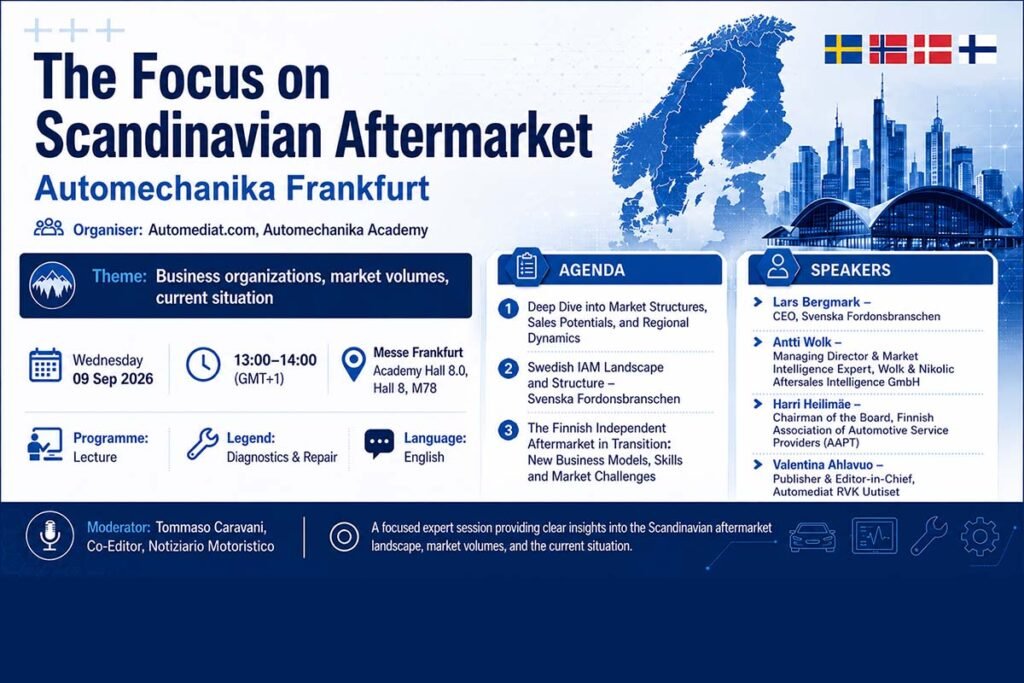
“The Focus on Scandinavian IAM,” Wednesday, September 9, 1:00–2:00 p.m.
Organizers: Automediat.com and Messe Frankfurt.
Location: Automechanika Academy, Hall 8.0. The event is part of Automechanika Frankfurt’s international expert program.
The event will examine the structure, market volumes, and future prospects of the automotive aftermarket in all the Nordic countries. Held on the Academy Stage, the event will feature speakers from spare parts and repair shop industry associations in Finland, Sweden, and Denmark, as well as a leading expert specializing in international market data.
Key themes of the event include market structure, electrification, trends in the vehicle fleet, skill requirements for repair shops, the spare parts market, the importance of data, sustainable development, and industry regulation.
Antti Wolk will discuss the structure and potential of the Nordic aftermarket
A broader market overview will be presented by Antti Wolk, CEO and partner at Wolk & Nikolic Aftersales Intelligence GmbH.
Wolk’s presentation, “The Nordic Automotive Aftermarket – Deep Dive into Market Structures, Sales Potentials, and Regional Dynamics,” focuses on the structures of the Nordic aftermarket, sales potential, and regional differences.
Wolk & Nikolic specializes in research, market data, and business intelligence solutions for the international automotive aftermarket. Wolk’s perspective provides comparable market data and a broader European perspective to complement the country-specific presentations.
The slow renewal of Finland’s vehicle fleet is affecting the aftermarket
Finland will be represented at the event by Harri Heilimä, Chairman of the Board of the Association of Automotive Service Providers (AAPT). His presentation, “How Has Electrification Affected Finland’s Automotive Aftermarket?”, examines the impacts of electrification, particularly from the perspective of the structure of Finland’s vehicle fleet.
Finland’s vehicle fleet is being renewed slowly. According to Heilimä, this is reflected in the aftermarket as two parallel trends: electrification is advancing, but at the same time, a large number of older internal combustion engine vehicles will remain on the road for a long time. The need for maintenance and repairs of the older vehicle fleet sustains the workload of independent repair shops, while the technology of the newer fleet places new demands on repair shops in terms of expertise and equipment.
The presentation also addresses the impact on the repair shop sector of regulations concerning batteries, their repair, and the use of used replacement parts.
In Sweden, the focus is on expertise, sustainability, and a level playing field
Lars Bergmark, CEO of Svenska Fordonsbranschen, will present the Swedish aftermarket. The organization brings together approximately 2,000 independent aftermarket repair shops and wholesale operators.
In his presentation, Bergmark will examine the structure of the Swedish IAM market, the organization of the industry, and key current issues affecting the operating environment.
Svenska Fordonsbranschen’s work emphasizes, among other things, the availability of a skilled workforce, sustainable development, and a level playing field for the independent aftermarket. Bergmark also has extensive experience in the tire industry; prior to his current role, he held management positions at international tire manufacturers.
International Discussion on the Nordic IAM Market
The event will be moderated by Tommaso Caravani, a leading Italian journalist and publisher in the aftermarket sector. Following the country-specific presentations, the program will feature a panel discussion on the development of the Nordic aftermarket and future challenges.
“The Focus on Scandinavian IAM,” curated by AUTOMEDIAT.COM, brings the perspective of the independent aftermarket in Finland and the other Nordic countries to the international Academy program at Automechanika Frankfurt.
Automechanika Frankfurt will take place September 8–12, 2026. Automediat.com will report on the events at the trade show and will pay particular attention to developments in the aftermarket and repair shop sectors.